Showing posts with label Cultural Revolution. Show all posts

Tuesday, March 20, 2012

A Cave With A View ('Life is easy and comfortable here")


Someare basic, others beautiful, with high ceilings and nice yards. 'Life is easyand comfortable here,' one cave dweller says.


ByBarbara Demick, Los Angeles Times
March18, 2012
Reportingfrom Yanan, China— 


Like many peasants fromthe outskirts of Yanan, China, Ren Shouhuawas born in a cave and lived there until he got a job in the city and movedinto a concrete-block house.

   
His progression made sense as he strove to improve his life. Butthere's a twist: The 46-year-old Ren plans to move back to a cave when heretires.
  
"It's cool in the summer and warm in the winter. It's quiet andsafe," said Ren, a ruddy-faced man with salt-and-pepper hair who moved tothe Shaanxi provincial capital, Xian, in his 20s. "When I get old, I'dlike to go back to my roots."


Cave dwelling entrance


More than 30 million Chinese people live in caves, many of themin Shaanxi province where the Loess plateau, with its distinctive cliffs ofyellow, porous soil, makes digging easy and cave dwelling a reasonable option.

   
Each of the province's caves, yaodong, in Chinese,typically has a long vaulted room dug into the side of a mountain with asemicircular entrance covered with rice paper or colorful quilts. People hangdecorations on the walls, often a portrait of Mao Tse-tung or a photograph of amovie star torn out of a glossy magazine.


Ma Liangshui, 76, haslived in caves around Yanan his entire life. (Barbara Demick, Los Angeles Times/ February 1, 2012)


The better caves protrude from the mountain and are reinforcedwith brick masonry. Some are connected laterally so a family can have severalchambers. Electricity and even running water can be brought in.

    
"Most aren't so fancy, but I've seen some really beautiful caves:high ceilings and spacious with a nice yard out front where you can exerciseand sit in the sun," said Ren, who works as a driver and is the son of awheat and millet farmer.

    
The caves have an important role in modern Chinese history. TheLong March, the famous retreat of the Communist Partyin the 1930s, ended near Yanan, where Mao took refuge in caves. In "RedStar Over China," writer Edgar Snow described a Red Army university that"was probably the world's only seat of 'higher learning' whose classroomswere bombproof caves, with chairs and desks of stone and brick, and blackboardsand walls of limestone and clay."


Cave school


Chinese Vice President Xi Jinping, who isexpected to succeed Hu Jintao next year aspresident, lived for seven years in a cave when he was exiled to Shaanxiprovince during the Cultural Revolution.

    
"The cave topology is one of the earliest human architecturalforms; there are caves in France, in Spain, people still living in caves inIndia," said David Wang, an architecture professor at Washington StateUniversity in Spokane who has written widely on the subject. "What isunique to China is the ongoing history it has had over two millenniums."


Sometimes called thebiggest maze of China, Guyaju is an ancient cave house located about 92kilometers (57 miles) from Beijing. No precise record of it has ever beenfound, so no one knows its exact origins. The house was hewn from the craggycliffs overlooking Zhangshanying Town. The intriguing house complex has morethan 110 stone rooms, and is the largest cave dwelling ever discovered inChina.


In recent years,architects have been reappraising the cave in environmental terms, and theylike what they see.

    
"It is energy efficient. The farmers can save their arable landfor planting if they build their houses in the slope. It doesn't take muchmoney or skill to build," said Liu Jiaping, director of the GreenArchitecture Research Center in Xian and perhaps the leading expert on caveliving. "Then again, it doesn't suit modern complicated lifestyles verywell. People want to have a fridge, washing machine, television."

       
Liu helped design and develop a modernized version of traditionalcave dwellings that in 2006 was a finalist for a World Habitat Award, sponsoredby a British foundation dedicated to sustainable housing. The updated cavedwellings are built against the cliff in two levels, with openings over thearchways for light and ventilation. Each family has four chambers, two on eachlevel.


Cave dwelling interior


"It's like living in avilla. Caves in our villages are as comfortable as posh apartments in thecity," said Cheng Wei, 43, a Communist Party official who lives in one ofthe cave houses in Zaoyuan village on the outskirts of Yanan. "A lot ofpeople come here looking to rent our caves, but nobody wants to move out."

    
The thriving market around Yanan means a cave with three roomsand a bathroom (a total of 750 square feet) can be advertised for sale at$46,000. A simple one-room cave without plumbing rents for $30 a month, withsome people relying on outhouses or potties that they empty outside.

  M
anycaves, however, are not for sale or rent because they are handed down from onegeneration to another, though for just how many generations, people often can'tsay.


Cave decorated for awedding, Hubei province 


Ma Liangshui, 76, livesin a one-room cave on a main road south of Yanan. It is nothing fancy, butthere is electricity — a bare bulb dangling from the ceiling. He sleeps on a kang,a traditional bed that is basically an earthen ledge, with a fire underneaththat is also used for cooking. His daughter-in-law has tacked up photographs ofFan Bingbing, a popular actress.

    
The cave faces west, which makes it easy to bask in the lateafternoon sun by pulling aside the blue-and-white patchwork quilt that hangsnext to drying red peppers in the arched entrance.

    
Ma said his son and daughter-in-law have moved to the city, buthe doesn't want to leave.

    
"Life is easy and comfortable here. I don't need to climb stairs.I have everything I need," he said. "I've lived all my life in caves,and I can't imagine anything different."


Fan Bingbing


NOTE: 


Having just reviewed Jane’s “A RoomWith A View” essay with this  fascinatingLA Times article fresh in my mind, Ithink I might be happy and content in a “cave with a view.”  

We used to stay at a hotel (our favorite place in the world)called Twin Dolphin in LosCabos where the accommodations were verypleasantly cave-like.  The walls of the varioushotel buildings were even festooned with  replicas of ancientindigenous Baja Sur paintings, nicely driving the chthonic feeling home.  


Although it was eventually overtaken in the LosCabos fashionability  stakes by less distinctive, but grandly luxurious competitor hotels (there are people who like to say they love Mexico, but they really do not), duringthe years we visited there, spelunking in and around Twin Dolphin was The Answer To Everything.  


The Answer ToEverything: Del Shannon (wr: Hilliard - Bachrach, 1961)(link)


Thursday, February 9, 2012

As Clear as Tofu and Scallions: The Cultural Revolution Cookbook


INTRO:  


Of my various 2011 "Christmas books" (they ranged fromvolumes of political  analysis  and invective to artistic, natural history andculinary works), my absolute favorite was The Cultural Revolution Cookbook by Sasha Gong andScott D. Seligman.


When I first read about the book's impending publication, Ithought it must be a sort of joke item.  Remembering the CulturalRevolution, one tends to think about politicalterror, acts of terrible and confusing cruelty, social destruction and materialprivation, rather than cuisine.


During the Cultural Revolution


But Sasha Gong, a Chinese-bornAmerican academic whose family was relocatedfrom Guangzhou to Hunan province during the Cultural Revolution,significantly interrupting her schooling, has in this handsome, beautifullywritten and sensibly priced book, transformed proverbial lemons into lemonadeas she tells the story of learning by necessity to live, cook and eat simply in the countryside, growing, preparingand sharing pure, good and traditional food.


I have been cooking from the excellent,delicious recipes in this book non-stop and I am pleased to present you with one of Ms. Gong'ssimplest, easiest and best meals.  If you want, you can elaborate on itby adding minced or sliced ginger,  hot chilies or various types of pickledvegetables .  It's splendid as is, however, and the title of this post,explained in the text following the recipe -- "Asclear as tofu and scallions" -- used as a simile for  integrity orflattering sobriquet -- is an image I understand and find very moving.  


 Tofu


TofuWith Scallions and Sesame Dressing


Ingredients


1 scallion
1 cake firm tofu (bean curd)
2 tsp. sesame oil
Pinch of salt


Tofu was invented in 164 BC bya Chinese nobleman trying to make medicine, and it has taken its rightful place asa major source of protein in the Chinese diet.  This amazingly simple dish is incredibly tasty,low in fat and high in protein.  Use a firm bean curd to make it becauseit will hold its shape better this way.


Shred the scallion into verysmall pieces, cutting it on the bias to maximize surface area.  Rinse the tofu and place it on a microwave-safe serving plate.  


Warm it by microwavingit on high for one minute, or simply heating it very gently in a conventionaloven.


         Remove the tofu from the oven, and with a sharp knife or cleaver, cut it up into small pieces about 1 ½ inches (4cm.) long, an inch (2.5 cm.) wide and about ½ inch (about 1.5 cm.) thick. 


         Sprinkle the scallion, sesame oiland salton top of the tofu pieces and serve while still warm.


Note:  There were obviously nomicrowaves in the Chinese countryside during the Cultural Revolution, nordid peasants have convection ovens.  They would simply have soaked the tofu – which would havebeen freshlymade – inhot water for 10 minutes to heat it up.


Sesame


Supreme Instruction – 
Struggle against selfishness and criticize revisionism’”


During the Cultural Revolution, people were often accused of offenses, from stealing or engaging in extra-marital affairs to slacking off or having “bad thoughts.”  Meetings ofvillage production teams were forums for dispute resolution where people wereoften compelled to criticize themselves or defend themselves against suchaccusations.  A good defense was toproclaim one’s loyalty and demonstrate knowledge of communist doctrine, with whateverrhetorical flourishes one could muster.  


     This dish – its milky white bean curd a sharp contrast to the deep green of its scallions – provided a useful metaphor.  Ifyour innocence was  ‘as clear as tofu and scallions,” then anyone ought to be able to appreciate it. 


Excerptedfrom:  The CulturalRevolution Cookbook by Sasha Gong and Scott D. Seligman (Hong Kong, Earnshaw Books, 2011)


Scallions


OUTRO:


Iconfess a deep and profound love for Chinese bean curd.  Although it is fine in this country, especiallywhen it is freshly made, it is out of this world in China. 


     Thinking about bean curd, which I probably do an abnormal amount,brings to mind the final testament ofthe Chinese poet Qu Qiubai, imprisoned and then executed by the Kuomitang because he was too ill to depart onthe October 1934 LongMarch.   One of his final acts was composing a goodbyenote, "Some SuperfluousWords," which after praising flowers,moonlight and factory chimneys, concluded byrecommending "AnnaKarenina" and "The Dream of the Red Chamber" and stating, last ofall, that "the Chinese bean curd is the most delicious food in the wholeworld.  Goodbye andfarewell!."


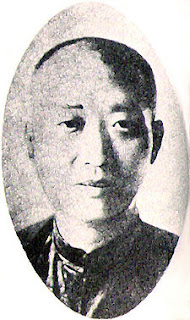
Qu Qiubai"Some Superfluous Words"


Thismakes me think of the author, Sasha Gong

Thursday, November 10, 2011

As The Little Red World Turns: Center for Chinese Studies at University of Michigan Rediscovers Rare Chinese Art Collection


"Chairman Mao Inspects the Cultural Revolution in Various Location," is shown in a Chinese papercut recently discovered at the Center for Chinese Studies at the university during a cleaning of a storage room. The papercuts portray the euphoria and zeal of the era as well as the violence and destruction that left the Chinese economy in shambles.


By: Jeff Karoub, Associated Press


ANN ARBOR (AP).- Propaganda pieces produced in China four decades ago during the Cultural Revolution have been unearthed in a storage room at the University of Michigan — a rare find in either the U.S. or its country of origin, experts said.

        The rediscovery of the 15 poster-sized papercut images illustrating the political upheaval of the era is a pleasant surprise to scholars studying a society that was largely closed off from the West. The images are cut out of red paper in the same way that artists customarily create decorations for Chinese New Year celebrations and other festivities. They include glowing portrayals of late Chinese leader Mao Zedong and Red Guards burning books and trampling on a Buddhist statue


Eliminating the Four Olds


        The handmade images were stored at the university's Center for Chinese Studies, which is celebrating its 50th anniversary. Carol Stepanchuk, the center's community outreach coordinator, found them while sorting through boxes in its storage room. She said the collection of 15 framed images "stood out." The frames weren't in great shape, but the images were in "remarkably good condition," she said. 


 Support the Army and Cherish the People


        Stepanchuk took them to her office and brought the find to the attention of faculty members, who marveled at the rarity and quality of an entire set that tells a coherent story.

        The late scholar Michel Oksenberg, who taught at the university for two decades, collected the papercuts while doing research in Hong Kong in the early 1970s and donated them to the center when he left in 1991 to lead the East-West Center in Honolulu. 


Rallying workers threatening to stab political enemies with giant fountain pens that look like spears.


     Ena Schlorff, the center's program coordinator, remembered the donation.

        "We were storing them for future consideration," said Schlorff, who had been Oksenberg's personal secretary. "It took the newer faculty ... to realize the current importance of this collection." 


"Long live the GreatProletarian Cultural Revolution!" says the slogan on the flag thatfeatures the profile of the late Chinese leader Mao Zedong.


        Associate history professor Wang Zheng said the collection was produced at a small, folk art institute in the southern province of Guangdong, and it most likely wasn't commissioned by Communist Party leaders. She said it shows how young artists at the time understood and related to the decade-long Cultural Revolution, and she plans to use one of the images in a book she is writing.

        "They did not have embedded interests in the establishment, and the Cultural Revolution was to smash the establishment," Zheng said. "The young ones who didn't have power ... likely identified with it." 


The papercut celebrates thenation's first Marxist big character poster, one of the most popular propagandatools in the Cultural Revolution. The image also praises editorial staff at thePeople's daily, the mouthpiece of the Communist Party, for writing about theposter.


        Zheng said it's rare for the English-speaking world to have access to such visual historical documents. Even in China, she said, this collection probably would not have survived because it features Mao alongside Lin Biao, who was accused of plotting a coup against Mao and deemed a traitor. He died in a plane crash while flying to the Soviet Union in 1971.

    "This whole project would be politically incorrect," she said.

      Xiabong Tang, a professor of Chinese literature and visual culture, said in a university release that the images are more valuable than others found online because of their complexity and detail. He estimated that each papercut could be worth more than $150 to a serious collector.

     The university has no immediate plans for a public display of the actual papercuts but has digitized the images and posted them online.


Chairman Mao is the Reddest Sun in Our Hearts


NOTE:  A fascinating story about a remarkable discovery, which will come as a not-so-great surprise to anyone who has ever spelunked around museum or library inventory spaces or cleaned out an attic.  Things turn up.  The World Turns.  One day you're "world-beating" China, wreaking havoc, spinning death-webs and having tea with Nixon and Kissinger; the next you're boxed and forgotten detritus.  The formal excellence and beauty of these images reminds me of the strange relationships between intelligence, knowledge, talent, common sense, ignorance, promise, politics, good, evil and justice.  Funny, confusing old world.  Mao's last "fan" (he even eventually lost Albania) seems to be that dreadful former White House communications director, Anita Dunn, who improably paired his philosophy as a moral polestar with that of Mother Teresa.  Funny, sad old world where popular comedy's Olympus now is the unfunny, predictable and tepid sarcasm of Stephen Colbert and Jon "Grimace At Everything" Stewart. 

A link to the University of Michigan website containing the complete collection of images (high res scans) and information is found HERE.