Dearest Bobbie, Since I saw you something has happened. Bosie’s father has left a note at my club with hideouswords on it. I don’t see anything nowbut a criminal prosecution. My whole life seems ruinedby thisman. The tower of ivory is assailed by the foul thing. On the sand is my life split. Idon’t knowwhat to do. If you could come here at 11:30 please do so tonight. Imar your life by trespassing ever on your love and kindness. I have asked Bosie to come tomorrow.
They bagged themselves several brace of pheasant at Sandringhamover Christmas.
But at the weekend Prince William and Prince Harry set theirsights on bigger game.
The brothers flew to Spain on Friday for a secret hunting trip tocelebrate the end of Harry's advanced helicopter training.
The royal pair were staying on an estate in the backwaters ofrural Cordoba owned by the Duke of Westminster, Gerald Grosvenor, Britain'sthird-richest man and one of William's godfathers.
Finca La Garganta
Finca La Garganta, near the village of Conquista, on the borderof Castilla La Mancha, is one of the largest and most exclusive hunting estatesin western Europe.
It is teeming with wildlife including wild boar and stag whichWilliam and Harry, both crack shots, are said to be keen to bag.
Wild Boar
Beaters and packs of dogs were brought in to ensure that theprinces did not return home without several 'kills' to their name.
The brothers have visited the estate before and last time weresaid to have bagged a staggering 740 partridge on a single day.
The second and third in line to the throne arrived in Spain onFriday on separate flights as they are not allowed to travel together in caseof an accident.
William , 29, who was not believed to be accompanied by his wife,the Duchess of Cambridge, flew into Seville while Harry, 27, arrived on aprivate jet at Cuidad Real Central later in the afternoon.
Partridge
They took up residence in a ten bedroom villa with a group offriends and their Scotland Yard bodyguards, one of three luxurious huntinglodges built at the heart of the estate at a cost of several million pounds bythe reclusive Duke.
It has marble floors, wooden beams - and its own jacuzzi andsauna.
The estate has just one – practically impassable – publicroad, its own petrol station and a fleet of armed security guards driving 4x4sto keep any undesirables at bay.
More than 15,000 hectares in size with a 40 mile perimeter, theFinca also boasts a private train station and accommodation for nearly100 staff.
It is understood that William took his then girlfriend, KateMiddleton, to the estate a couple of years ago when they took part in a wildboar and deer hunt involving hundreds of local beaters.
This Sporting Life In Spain -- 2011 -- Stag
According to one local employee, they killed 'dozens' of animalsthat day.
'They were mostly very good shots, ' said an estate employee.
Their latest trip was organised as an early celebration tomark Prince Harry's graduation as a fully operational Apache attack helicopterpilot.
This Sporting Life In Spain -- 2011 -- Partridge
He is due to be assigned to one of the Army Air Corps Apachesquadrons at RAF Wattisham in Suffolk and could be posted back to the frontlinein Afghanistan by the end of the year.
The holiday is also something of a farewell for William who isdue to be stationed in the Falkland Islands with his RAF Search and Rescue crewfor six weeks from next month.
This Sporting Life In Spain -- 2011 -- Wild Boar
Locals said the princes remained on the estate all weekend andwere due to fly back yesterday.
AClarence House spokesman said: 'We cannot discuss the movementof the princes as they are on a private weekend.'
Modern rendering of Wild Boar painting in cave at Altamira, Spain, ca. 14,000 B.C. "After Altamira, all is decadence" (attributed to Picasso).
John Butler Yeats: Portrait of Elkin Mathews, 1893, Charcoal and pencil.
TO ELKINMATHEWS
Ms Princeton
29boulevard des capucines
[postmark 21November 1891]
Dear MrElkin Mathews, I have been in Paris for the last month, and will not be inLondon for some weeks longer. Withregard to Mr Ricketts, of course he must be paid for his design on itscompletion. I mention this as I do notknow whether it is on the question of money that he has written to you. Pray let me know by return what he wanteddone.
This settled, I will ask Osgood &Mcilvaine to hand you over the copies, and the book could be got out after therush of Xmas books is over.
I think that as the edition will belimited each copy should be signed by the author. This will give a special character to theedition. I remain truly yours
OscarWilde
Oscar Wilde, Poems. London, Elkin Mathews and John Lane, 1892.
NOTES:
1.Elkin Mathews (John Lane's partner in the Bodley Head bookselling business in Vigo Street, London) published a new edition of Wilde's Poems on May 26, 1892 using and binding unsold sheets of the 5th Bogue edition of 1882. The work, the first under the joint imprint of Mathews and Lane, was a limited edition of 220 copies, each signed by Wilde, and priced at 15 shillings.
2.Wilde received all proceeds from the new edition of thePoems, less five guineas for Charles Ricketts, who designed the title page, half title and cover, five guineas for advertising and the publisher's 20 percent share.
3.Charles de Sousy Ricketts, the Swiss-born English painter, illustrator and theatrical designer, was one of the two well-known illustrators of Oscar Wilde's work. (Aubrey Beardsley, illustrator of Salome, was the other.) Ricketts and his life-partner Charles Haslewood Shannon were friends and supporters of Wilde, for whom Ricketts painted, in the style of Clouet, the hero of Wilde's short storyThe Portrait of Mr W H. In 1932 Ricketts published the memoir Oscar Wilde: Recollectionsunder the pseudonym Jean Paul Raymond.
4. This letter, like so much of Wilde's correspondence -- whether high-flown or quotidian in subject matter -- reads as though it could have been written yesterday. I write this as I myself prepare for the "rush of Xmas books," and the rest of the season's scuffle.
5. Those readers interested in this, might also like This and This.
Charles Haslewood Shannon, Portrait of Charles de Sousy Ricketts, 1898, oil on canvas.
It was arranged last year that I should send in my income-tax return from Chelsea where I reside, as I am resigning my position here and will not be with Messrs Cassell after August. I think it would be better to continue that arrangement. I wish your notices were not so agitating and did not hold out such dreadful threats. A penalty of fifty pounds sounds like a relic of mediaeval torture,
Your obedient servant,
OSCAR WILDE
Reader note: Text from Cassell's Weekly, 2 May, 1923
Oscar Wilde in 1889
This post is dedicated to my wife Caroline, who suggested it. Happy anniversary, Caroline.
Ronald Colman (l), Bert Lytell (c), May McAvoy (r), Lady Windermere's Fan, 1925, dir. Ernst Lubitsch
To Herbert Home
MS Fales
[Postmark 28 January 1891]
16 Tite Street
My dear Home, Many thanks, but I am dining out, otherwise I would come with pleasure to hear you read some delicate Herrick-like song, and Lionel read that sonnet on Wormwood that so fascinated me. Ever yours.
Oscar Wilde
The Duchess of Padua, Manuscript title page, 1883
To Arthur Clifton
MS Clark
[Postmark 28 January 1891]
16 Tite Street
My dear Arthur, The new last line ‘Paradise’ is charming. ‘Vice does not do as it is a word tainted in its signification with moral censure – vitium: what is faulty.
The evening was charming. I enjoyed it all. Ever yours.
Oscar
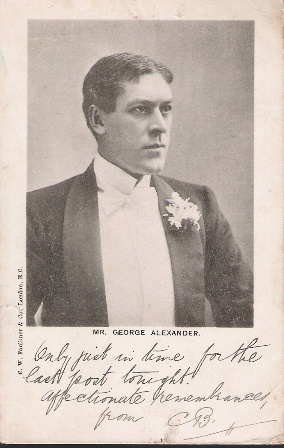
Actor, Theater Manager George Alexander, ca. 1901
To George Alexander
MS Arents
[2 February 1891]
16 Tite Street
My dear Aleck, I am not satisfied with myself or my work. I can’t get a grip on the play [1] yet: I can’t get my people real. The fact is that I worked at it when I was not in the mood for work, and must first forget it, and then go back quite fresh to it. I am very sorry, but artistic work can’t be done unless one is in the mood; certainly, my work can’t. Sometimes I spend months over a thing, and don’t do any good; at other times I write things in a fortnight.
You will be interested to hear that The Duchess of Padua was produced in New York last Wednesday, under the title of Guido Ferranti, by Lawrence Barrett. The name of the author was kept a dead secret, and indeed not revealed till yesterday when at Barrett’s request I acknowledged the authorship by cable. Barrett wires to me that it was a huge success, and that he is going to run it for his season. He seems to be in great delight over it.
With regards to the check for 50 pounds you gave me, shall I return you the money, and end the agreement, or keep it and when the play is written let you have the rights and refusal of it? That will be just as you wish.
I am delighted to hear you had a brilliant opening at the St. James’s. Ever yours.
Oscar Wilde
[1] Lady Windermere's Fan
To Edward Lawson
MS Private
[2 February 1891]
16 Tite Street
Dear Mr Lawson, The delightful article in your issue of this morning has inspired the enclosed letter. I don’t wish to sign my name, though I am afraid everybody will know who the writer is: one’s style is one’s signature always.
I think, however, that the subject of modern dress is worth discussing, and of course yours is the paper that is in quickest touch with the public, and to which the public look for a topic to write on. Believe me, truly yours
Oscar Wilde
I know you like news of the stage. This will be news. On Wednesday last a blank verse romantic drama in five acts, called Guido Ferranti, was produced in New York by Mr Lawrence Barrett. The name of the author was kept a profound secret. The play achieved an immense success and excited much curiosity. At Mr Barrett’s request the author revealed himself on Sunday by cable. It was Mr Oscar Wilde. He was anxious to have the play judged entirely on its own merits. The result has justified his expectations. The play is running to crowded houses.
From ArtDaily.org, 9-25-10: "In another of the pictures, a comically frightened-looking Monroe is in the clutches of a taxidermy bear."
The amusing photograph above appeared on the ArtDaily.org website yesterday as part of a publishers's announcement for the new Calla Editions book, Marilyn: August 1953, released this week.
The photographs contained in the book were taken by LOOK magazine photographer John Vachon, on assignment in Alberta, Canada, where Monroe was filming "River of No Return" with Robert Mitchum.
According to the article: "An injured ankle prevented Monroe from filming, allowing Vachon to have several days to shoot the Hollywood icon. Only three of photos from the sessions were published in an October 1953 LOOK story. The book will feature photos of Monroe and then fiance, baseball legend Joe DiMaggio snuggling."
I mention all this here for two reasons. First, I would not wish to stand in the way of the Marilyn Monroe Business, which will apparently roll on forever, and I have no problem passively supporting their efforts. Second, I only recently became consciously aware of the extraordinary photographic oeuvre and career of John Vachon. (I say consciously because Vachon's photography career included long stints on staff at Life and LOOK. No one who grew up in the era when those magazines were being published could not have seen many of Vachon's images.)
The source of my Vachon awareness is the "poetry-art blog" of the major American poet Tom Clark called Beyond The Pale. Over the past several months on BTP, Clark has turned his attention to the photographs produced of United States life during the Great Depression by the team of master photographers working under the direction of Roy Stryker at the United States Farm Services Administration. Vachon, who began as a non-photographer staff assistant and found his eye and metier during the FSA project, became part of the remarkable FSA crew, which also included Dorthea Lange, Jack Delano, Arnold Rothstein, Russell Lee and others. Some examples from Tom Clark's site featuring both Vachon's black and white and his extraordinary color photography are found here and here again. Once you see Vachon's work, I think you will agree that it is impossible to overstate his talent.
I would recommend that anyone interested in photography, American history and how present day life is prefigured in past events, consult Tom Clark's blog and become familiar with his extraordinary historical recovery project, as well as the other materials posted there. To date, only a small percentage of the negatives in the FSA photography archive have been published. They were paid for and belong to the American people and we should all avail ourselves of this extraordinary resource.
I don't have Tom Clark's eye, but a couple of Vachon shots that don't appear on Beyond The Pale are posted below, as well as a charming portrait of Vachon himself. I have also included a Joe Dimaggio and Marilyn shot from the new book and an extraordinary Vachon image, which Tom Clark did previously publish showing an up-close look at two peeling billboard advertising posters. The American Pop artist James Rosenquist must have been aware of any influenced by Vachon's keen and knowing eye.
John Vachon: Three photographs of Armistice Day Storm, November 11-12 1940 (top Lyman County, South Dakota; Center: Watkins, Minnesota; Bottom: Draper, South Dakota).
John Vachon, May 1940 Farm Services Administration photograph of billboard with peeling posters.
John Vachon: Mrs. Ballnger, Wife of an FSA borrower, March 1942, Flathead County, Montana
John Vachon
Oscar Wilde
Because of the ridiculous number of Google News Alerts I have signed up for over the years, very little of little importance gets by me and escapes my attention. I can reliably report to you that the Parmenides front remains (and is likely, in my opinion, to remain) quiet and that all that ever occurs on the Heraclitus border are frequent nearly identical-in-every-instance reminders that change is constant (pretty funny, I think).
Oscar Wilde, however, remains fertile daily news territory, almost on the order of Justin Bieber or Lady Gaga. Not a day goes by without multiple Wilde mentions and citations. Usually they take the form of witty ripostes or ironic observations. Re-reading The Picture of Dorian Gray recently, I was astonished to see that, like the Bible and Shakespeare, Wilde seems to be the source and author of most of the thoughts people try to express and claim as their own.
This week's Wilde story was a little different and involved a cache of five letters written by Wilde to a young London editor he apparently admired named Alsagar Vian in 1887, which were auctioned in England last week for about L34,000, exceeding the L10,000 pre-sale estimate.
The letters, which have been in the possession of Vian's heirs until now, are said to contain more documentary evidence than has heretofore been available about Wilde's homosexual leanings, which are alleged to be revealed in his repeated invitations for Vian to meet and dine with him to discuss literary and magazine editorial matters.
Not having read the letters in their entirety, I cannot comment reliably on the accuracy of this, but among the excerpts that have been published in the newspapers, I did notice this highly amusing interpretation by the Indian press agency ANI (which was widely picked up and republished in the Indian news) concerning the "key" fifth and final letter.
ANI reported yesterday that:
"In the final letter, he went at great lengths to encourage a naked meeting over a flask of wine".
However, what the text of the letter actually says is:
"Come and dine at Pagani's in Portland Street on Friday, 7:30 pm. No dress, just ourselves and a flask of Italian wine."
Readers of Wilde's letters (and people generally familiar with the manners of Wilde's time) will already be aware that Wilde was extending a more or less casual invitation to Vian to dine in a public restaurant that did not require formal evening attire, rather than one where his companion would be asked to pose for an updated version of Manet's "Le Dejuener Sur L'herbe".