Showing posts with label Le Caprice. Show all posts

Tuesday, March 22, 2011

A Profound Love Of Nature (Isle of Typhoeus)


Olive Tree, Ischia


         Now, if my friend had come to Ischia instead of poisoning himself with fusel oil sold as whisky by honest colonial traders, he might have drunk as much as he pleased and been all the better for it.  For wine is the water of Ischia, and as a vino da pasto it is surpassed by none other south of Rome.  Indeed, it is drunk all over Europe (under other names) and a pretty sight it is to see the many-shaped craft from foreign ports jostling each other in the little circular harbour, one of the few pleasing mementos of Bourbon misrule.  The Austrian, battling with his Paprikahendl, or the Frenchman ogling his omelette and his yard of bread, little dream how much Ischia has contributed to their Gumboldskirchner or vin ordinaire.  Try it therefore through every degree of latitude on the island, from the golden torrents of thousand-vatted Forio up to the pale primrose-hued ichor, a drink for gods, that oozes from the dwarfed mountain grapes.  Try also the red kinds.


The waters of Ischia


        Try them all, over and over again.  Such at least was the advice of a Flemish gentleman whom I met in bygone years in Casamicciola.  Like most of his countrymen, Mynheer had little chiaroscuro in his composition; he was prone to call a spade a spade; but his ‘rational view of life’, as he preferred to call it, was transfigured and irradiated by a profound love of nature. Where there is no landscape, he used to say, there I drink without pleasure.  ‘Landscape refines.  Only beasts drink indoors.’ Every morning, he went in search of new farmhouses in which to drink during the afternoon, and late into the evening.  Every night, with tremendous din, he was carried to bed.  He never apologized for this disturbance; it was his yearly holiday, he explained.  He must have possessed an enviable digestion, for he was up with the lark and I used to hear him at his toilette, singing strange ditties of Meuse or Scheldt.  Breakfast over, he would sally forth on his daily quest, thirsty and sentimental as ever.  One day, I remember, he discovered a farmhouse more seductive than all the rest—‘with a view over Vesuvius and the coastline, a view, I assure you of entrancing loveliness!’  That evening he never came home at all…….

Excerpt from Isle Of Typhoeus (1909)  -- Norman Douglas


Zeus hurling his lightning at Typhoeus, Chalcidian black-figured hydra, ca. 550 BC, Staatliche Antikensammlungen, Munich


Reading Norman Douglas's Isle Of Typhoeus, written when Douglas was already 41, midway between his first book Unprofessional Tales (1901) and his most famous novel South Wind (1917), both calms me down and lifts me up, two things I find I need very much these days.  

        I learn so much so enjoyably and easily from Douglas that I don't even mind when the gaping holes in my education are revealed in super-high relief (or, as I suppose I should say, high-definition void).  I'd like to think there's still time to rectify (or at least ameliorate) the situation and definitely time to steer (I would like to say, "continue to steer") Jane on the right course in her own studies. 

        "The Frenchman ogling his omelette and his yard of bread". That's really great, I think, and so is all the rest, which immediately takes up permanent residence in memory and reference frame.

         I wasn't sure at first why Ischia was referred to as the Isle Of Typhoeus in Douglas's title, but if you are interested, you can find a great deal of information about the terrible Typhoeus, father both to Cerberus, the three-headed dog guarding the gates of Hades, and Chimera, monstrous fire-breathing female creature of Lycia in Asia Minor, composed of the parts of multiple animals (upon the body of a lioness with a tail that ended in a snake's head, the head of a goat arose on her back at the center of her spine):  Here


William Blake, Cerberus. Pen, ink and watercolor over pencil and black chalk, Date unknown (18th century), National Gallery of Victoria, Australia


       Regarding Typhoeus's relation to trapezoidal Ischia, largest of the islands in the Bay of Naples and neighbor to Douglas's compass point, Capri, some versions of the complicated and sometimes contradictory Typhoeus stories inter the vanquished monster underneath Mount Etna in Sicily, but others bury his tangled corpse under the sea at Ischia, giving birth to the island.  


Eternal fires of Chimera in Lycia, Turkey


         As an Ischia tourist website puts it (in slightly awkward, but still servicable, English translation): 

        "According to a legend, the Isle of Ischia was born out of the body of the giant Typhoeus, son of Tartarus and Gaia, who gave him birth with the intention to transform him into an opponent of Zeus and avenger of Cronus, whom she wanted the throne of the gods to be given back.  He looked like a monster with hundreds of snake heads, burning eyes and a voice "now as of a superb bull, with a strong low and an unrestrainable power, now similar to the barking dogs, a marvel to be heard, now whistling and echoing in the big mountains."  The giant, faithful to his mother's teachings, rebels to Zeus, who gets very angry and during a fight throws him into the "depths of Tartarus".  Homer himself mentioned the myth of Typhoeus in his Iliad (II 780-783), but he set the whole scene in the land of the Arimi: "Thus marched the host like a consuming fire, and the earth groaned beneath them when the lord of thunder is angry and lashes the land about Typhoeus among the Arimi, where the say Typhoeus lies." Thus Typhoeus was thrown down the Olympus and generated the island of Ischia.  Today many areas of the island are said to owe their name to the parts of the giants body: Piedmonte (at the feet of the mountain), Testaccio (head), Panza (belly), Cigilo (eyebrow), Molara (molar), etc........."


Ischia


         Adding to the relaxed, late afternoon-early evening, change-of-seasons, vino da pasto atmosphere that I hope suffuses this post, you will find below an interesting 1952 (the year Douglas passed away in Capri) photograph of W.H. Auden in Ischia seated between his portrait and portraitist, Bolivar Patalano.  Patalano, a well-known Ischian painter, according to his dealer, Philip Dawes, "lived for about 20 years in the U.S.A., of which ten were spent in prison for the murder of someone with whom he had a drunken brawl  It was in prison that the psychiatrist suggested that he take up painting as a means of calming his emotions and thus he took to painting like a duck to water."

        I like the photo; I wonder what Auden thought of the portrait?


Reader Note: Click on all images to enlarge.

Saturday, January 29, 2011

He Drew The Line At Snoek (Jean Conil)


"But even he drew the line at snoek" is a line taken from The Telegraph's (London) May 1, 2003 obituary of the legendary,  "French-by-birth, English-by-adoption", chef and culinary authority Jean Conil (1917-2003).

        For a few weeks I have been working out in my mind strategies for developing an essay/presentation about Conil's 1959 book, A Gastronomic Tour de France, a masterwork that until very recently had been staring down at me, unopened and unread, from various of my and my parents' bookshelves for nearly 50 years.


        Success has so far eluded me.  The book, handsomely published in London by George Allen & Unwin, Ltd. in 1959 and in New York by Dutton in 1960, presents gracefully and economically in its scant (considering the range and complexity of its subject) 300 pages more useful information for the culinary visitor to France than I could have imagined possible before opening its pages.  Conil simply addresses everything you might wish to know regarding every region and sub-region of France, i.e., regional political and social history; geography; agriculture; viticulture; art history; places of touristic interest, including restaurants, hotels and inns; and representative regional recipes, all in good and stimulating prose.  


        The book simulates a large-format photograph of France in the late 1950s seen through the particular lens of a man with a specialized genius, but a highly catholic point of view . Because the  world has changed during the last half-century, its current usefulness as a "tour" may have dwindled.  But I challenge anyone reading the book not to want to hop into the Way-Back Machine, setting the dial to, say Haute-Vienne (Marche),1959, to achieve their own, more genuine "Sputnik moment" than the sorry, ersatz article currently being peddled.


Le Caprice


F & M

        Jean Conil (1918-2003) was well-known in his adopted country as the man who (like his contemporary Elizabeth David) regarded the imaginatively impoverished state of British cuisine following World War II as a national "tragedy". A prominent chef and restauranteur (the Savoy Hotel, Le Caprice, Fortnum & Mason), caterer (the coronation of Queen Elizabeth II), journalist and television personality, The Telegraph observed when he passed away:

"It was not the ingredients that were the problem, he believed, but the way they were prepared.  'What we need is good chefs and a good cuisine', he argued. 'If Mr Atlee and Sir Stafford Cripps would eat a solid, well-cooked meal, perhaps they would find themselves better-equipped to discuss affairs of state.  Good business and good diplomacy depend on good food'. 

People tended to blame Britain's poor cuisine on rationing, but Conil maintained that good meals could be prepared with the most humble ingredients.  'Only take sausage meat, onions, parsley, carrots, peas, and some dried egg and you can turn out a meal fit for anyone'. . . . .But even he drew the line at snoek."


Queen Elizabeth II at her coronation, June 2, 1953


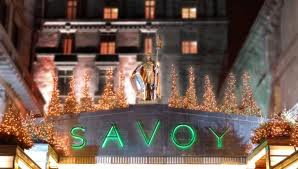
Portico of The Savoy, London


        Until I read the Conil obituary, I had never heard of snoek, but I was immediately strongly motivated to learn what this most discriminating, but imaginative and tolerant, of culinary evangelists considered to be beneath consideration. 


        Because of the internet, wonder of our age, my research almost instantly yielded highly fascinating results about this important food fish, treasured by the residents of South Africa, from a variety of sources. Essentially, snoek's (the fish is a form of perch; the name is Afrikaans) terrible reputation in England is a legacy of World War II food rationing.  The South African food blogger (resident in the UK ) and barrister CookSister writes: "During World War II, when everything was scarce, food rationing was rife, and cheap sources of protein were few and far between, somebody had the bright idea to catch cheap fish in South Africa, can it and ship it to England.  Suffice it to say that it did not go down too well over here.  The Web is full of war years recollections penned by people who remember this weird fish with the hugely amusing name arriving and being inedibly bad.  A large proportion of the tins that were imported remained firmly on shop shelves (despite optimistic suggestions from the Ministry of Defence -- like Snoek Piquante, which seems to have become a kind of shorthand for everything unpalatable about food rationing."


 Three aspects of World War II food rationing 

        
        CookSister goes on to say that: "For those of us in South Africa, it's a very different story.  Snoek is one of the great culinary pleasures of the Western Cape (the province surrounding Cape Town.  The flesh is oily and presumably packed with all the health benefits that oily fish brings; the meat is firm and strongly flavoured, rather like mackerel on steroids".  


         In South Africa, snoek is enjoyed either fresh, salted or smoked. Apparently it is marvelous cooked whole on the grill (or braii) or transformed into a pate, which is how it is most commonly served in restaurants, in the manner of smoked bluefish pate, which is more popular, I think, in the U.S., than bluefish eaten in other ways (something I'll never understand).   At Cape Town airport, sides of smoked snoek are available for purchase in the same way that you can purchase sides of smoked salmon in Ireland.  Snoek cuisine suggestions I have reviewed bring to mind the Spanish way with fresh sardines, another delicious oily fish.  A charming, possibly unpronounceable expression in the Afrikaans language, equivalent to "knock me over with a feather", is "slaat ma dood met 'n pap snoek" or "strike me dead with a limp snoek".


Smoking snoek


        Food memories endure because they intensely convey thoughts of happiness, grief, plenty and deprivation.  The mother of an old friend who was interned in France by the Germans during World War II never again touched turnips because they were fed to her daily during her imprisonment.  Even my own parents and my mother-in-law, who experienced relative luxury on the home front during the war, told stories of rationing that clearly formed a deep and permanent part of their life experience.

        I would like to try snoek one day.  It's right up my alley.  But, frankly, so is that trip in the Way-Back Machine.


        I would be remiss if I didn't provide at least one snoek recipe.  This one, which CookSister linked to (her own smoked snoek pate looks marvelous and could easily be adapted to our own bluefish or mackerel, I think), looks very enticing:  


Snoek With Coriander, Bacon and Orange


Ingredients

1 cleaned and butterfiled snoek
500 g back bacon
1 orange
1 bunch fresh coriander
Olive oil
Salt

Directions

1.  Place fresh, butterflied snoek on lightly oiled tin foil, flesh facing up
2.  Lightly salt the flesh.
3.  Squeeze over fish the juice of one orange.
4.  Chop all the coriander and cover the fish completely.
5.  Drizzle fish with olive oil.
6. Cook for 15-20 minutes, depending on thickness, in closed tin foil at 180 degrees C, and then open the tin foil and grill the bacon for a few minutes until crispy.


La Guienne in 1360


Boy Scout parade celebrating the coronation of Queen Elizabeth II